Invite and consent
Eligible patients are invited by their clinician and consent to structured SafeMed follow-up.
Controlled access evidence generation
SafeMed helps pharmaceutical companies and clinical teams offer supervised early access to novel treatments while capturing validated safety, effectiveness, and resource-use evidence in real time.
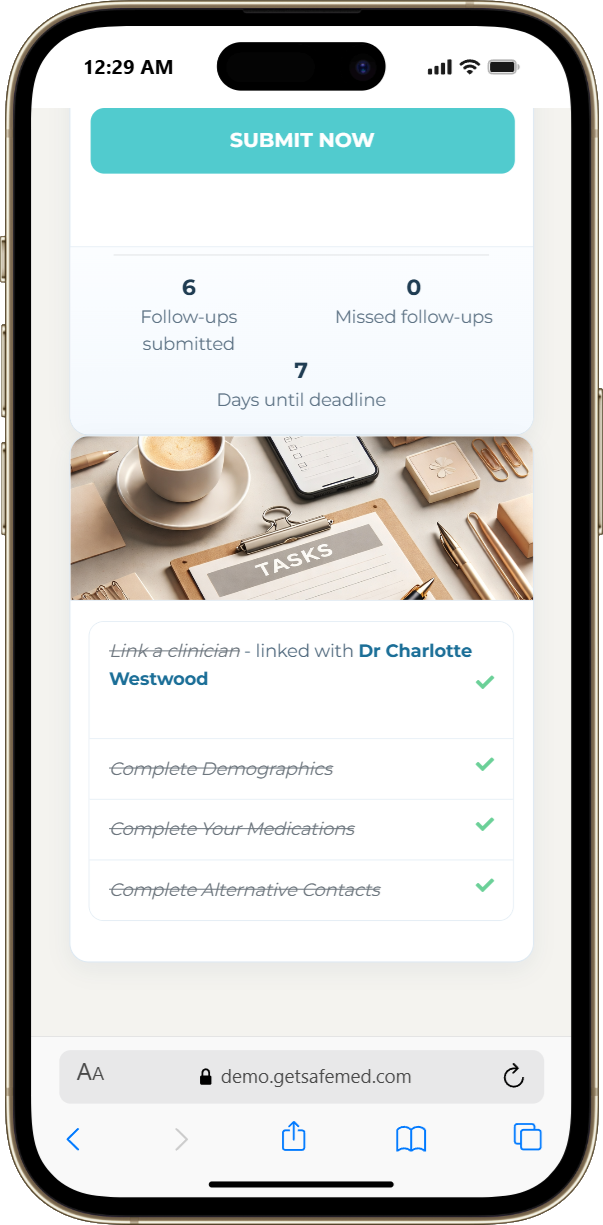
SafeMed is a consent-driven pharmacovigilance and follow-up platform for treatments where efficacy is promising but long-term safety, tolerability, real-world effectiveness, or cost-effectiveness evidence is still incomplete.
Patients report on a defined schedule. Adverse events are reviewed by SafeMed pharmacovigilance clinicians and the treating clinician. Prescribing decisions remain with the patient's clinician; SafeMed provides the control, validation, and evidence infrastructure around that decision.
By collecting a numerator (events submitted by patients via follow-up forms) and a denominator (treatment dose and duration), SafeMed generates data on the outcomes of exposure.
The gap
Rare serious adverse events, long-term safety, effectiveness in usual care, and resource-use evidence often emerge slowly. For orphan drugs, rare, serious, or patients who have exhausted all treatments, waiting years for perfect certainty can also be an ethical problem.
Conventional post-authorisation studies provide delayed data on effectiveness and adverse outcomes in usual care.
Whilst efficacy is clear, the lack of safety data is often a barrier to full market authorisation. Continuous data on exposure and outcome with conditional licensing is one possible solution.
Pharmaceutical companies, regulators and payers need high quality effectiveness, exposure, outcomes, toxicity, tolerability, and resource-use data.
The SafeMed model
The memorable rule is simple: no report, no treatment. The clinical reality stays nuanced: every reported event is assessed by the SafeMed pharmacovigilance team, while the treating clinician remains in control of prescribing or access.
Eligible patients are invited by their clinician and consent to structured SafeMed follow-up.
Medication, demographics, clinical context, and relevant outcomes are collected before exposure.
Patients complete scheduled forms and can report new safety concerns whenever they arise.
SafeMed reviews adverse events using structured coding and clinical validation workflows.
Clinicians receive timely safety context while aggregate evidence supports pharmaceutical companies and regulators.
For pharmaceutical companies
For regulators and clinicians
System overview
SafeMed gives patients a simple reporting experience while creating the structured audit trail needed by clinicians, pharmacovigilance teams, pharmaceutical sponsors, and regulators.

Evidence outputs
Continuous adverse event capture, clinical validation, and structured follow-up for every enrolled patient creates adverse event data.
Patient-reported outcomes and protocol-specific measures show how treatment performs outside trial conditions.
Health-economic evidence can be collected alongside safety and outcome data to contribute to supporting payer conversations.
SafeMed can contract with research organisations and specialist partners for regulatory, legal, operations, data management, and statistics.
Watch how the patient follow-up experience, controlled treatment release, and validated safety workflows come together to support supervised access and real-world evidence generation. Contact us at info@getsafemed.com for a full system demonstration.
Our team

CEO
Emeritus Professor of Clinical Pharmacology and Pharmacoepidemiology, and consultant physician at the University of Dundee School of Medicine at Ninewells Hospital, with decades of leadership in drug safety, clinical trials, pharmacoepidemiology, and real-world medicines evidence. Professor MacDonald established and led MEMO Research, co-chaired ENCePP, and has served as past President of both ISPE and BIHS, and is a fellow of the Faculty of Pharmaceutical Medicine. At SafeMed, this clinical and regulatory experience drives the vision for a platform that makes medicine monitoring more proactive, scalable, and reliable by generating data.

CTO
A research and technology background spanning clinical trial software, medical image analysis, signal processing, machine learning, and applied AI. Over 10 years at MEMO Research, work alongside Professor MacDonald included leading the development of clinical trial software used by thousands of participants, with a focus on study workflows, data capture, and safety monitoring. At SafeMed, this experience has shaped the platform from the ground up, turning complex medicine safety workflows into robust, secure, and usable software.
Start the conversation
Talk to SafeMed about early access, validated follow-up, and the real-world evidence package needed for confident regulatory and clinical decisions.